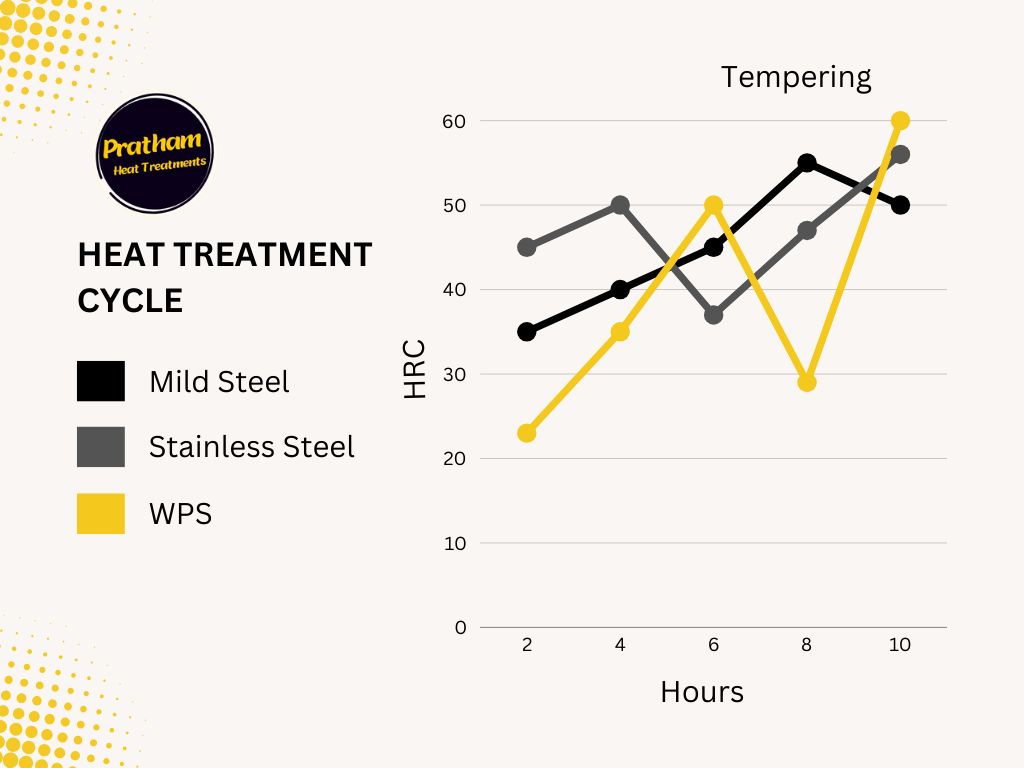
Key Concepts:
- Hardness:
- This measures a material's resistance to permanent deformation when a force is applied.
- It indicates how well a metal withstands scratching, indentation, or wear.
- Hardness Scales:
- Different testing methods produce different hardness scales. Common ones include:
- Brinell Hardness (HB): Uses a steel or carbide ball to create an indentation.
- Rockwell Hardness (HRC): Measures indentation depth using a diamond cone or steel ball.
- Vickers Hardness (HV): Employs a diamond pyramid indenter.
- Mohs Hardness: Primarily for minerals, it rates scratch resistance.
Purpose of a Metal Hardness Chart:
- Material Selection: Engineers use charts to choose metals with the right hardness for specific applications.
- Comparison: Charts allow for easy comparison of the hardness of different metals.
- Quality Control: Hardness testing and charts help ensure materials meet required specifications.
- Understanding Material Properties: Hardness is related to other mechanical properties like strength and wear resistance.
In essence, a metal hardness chart is a quick reference guide that allows people working with metals to understand the properties of those metals, and how those properties compare to other metals.
| HRC (Rockwell C) |
BHN (Brinell) |
| 20 | 229 |
| 25 | 255 |
| 30 | 285 |
| 35 | 324 |
| 40 | 375 |
| 45 | 429 |
| 50 | 495 |
| 55 | 578 |
| 60 | 698 |
| 61 | 720 |
| 62 | 746 |
| 63 | 774 |
| 64 | 806 |
| 65 | 839 |
| 66 | 876 |
| 67 | 917 |
| 68 | 960 |
| 69 | 1008 |
| 70 | 1059 |
Metal Hardness: A Fundamental Material Property
Definition
Hardness is a measure of a material's resistance to localized plastic deformation caused by indentation or scratching. It's not a single, absolute value, but rather a property that's determined by the material's microstructure.
Significance
Hardness directly impacts a material's:
- Wear resistance
- Strength
- Machinability
- Durability
Hardness Testing Methods and Scales
Brinell Hardness Test (BHN)
A hardened steel or tungsten carbide ball is pressed into the material's surface. The diameter of the indentation is measured, and the BHN is calculated.
Rockwell Hardness Test (HRC, HRB, etc.)
A diamond cone or steel ball is pressed into the material under specific loads. The difference in indentation depth is measured. Various Rockwell scales exist (HRC, HRB, HRA, etc.).
Vickers Hardness Test (HV)
A diamond pyramid indenter is pressed into the material. The diagonals of the indentation are measured, and the HV is calculated.
Knoop Hardness Test (HK)
A diamond pyramid indenter with an elongated shape is used. Primarily used for thin materials and coatings.
Mohs Hardness Scale
A qualitative scale based on scratch resistance, primarily used for minerals.
Metal Hardness Charts: A Practical Tool
Purpose
Metal hardness charts:
- Provide a quick reference for comparing hardness.
- Facilitate material selection.
- Assist in quality control.
Content
Charts typically include:
- Tables listing metals and their hardness values.
- Notes on testing conditions.
- Limitations of the data.
Limitations
Hardness values can vary due to:
- Alloy composition
- Heat treatment
- Testing conditions
Applications
Used in:
- Material selection
- Quality control
- Research and development
- Failure analysis
Factors Affecting Metal Hardness
- Alloying
- Heat Treatment
- Cold Working
- Grain Size
- Impurities