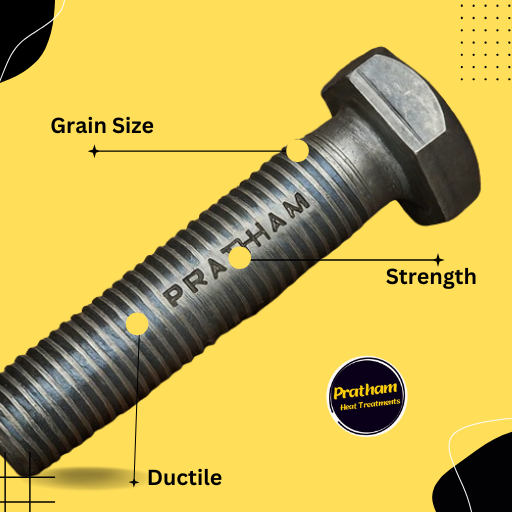
| Improves material properties (hardness, strength, ductility, toughness) |
Can be expensive, especially for complex or large-scale processes |
| Enhances wear resistance and fatigue life |
Requires specialized equipment and expertise |
| Allows for manipulation of microstructure for specific applications |
Can cause distortion or warping of the material if not controlled properly |
| Increases machinability in some cases (e.g., annealing) |
May reduce certain properties if not performed correctly (e.g., embrittlement) |
| Improves dimensional stability |
Some processes can be time-consuming |
| Can be used to join metals (e.g., brazing, soldering) |
May require subsequent finishing operations (e.g., grinding, polishing) |
| Improves corrosion resistance in some materials |
Risk of oxidation or decarburization if not performed in a controlled atmosphere |
| Can be applied to a wide range of metals and alloys |
Not suitable for all materials (e.g., some polymers) |
| Can be used to achieve specific surface properties (e.g., case hardening) |
The process can alter the surface finish of the material |